Last Updated: October 25, 2026
Quick Summary
Yes, you can replace seawall without removing it in many cases through in-place replacement, which reinforces, repairs, or rebuilds the wall while leaving the existing structure in the ground. This method saves time, reduces disruption, and often costs far less than full removal, though it works best when the foundation is sound and damage is localized.
- In-place replacement works best when the wall’s foundation is sound, damage is localized to the upper portion, and soil behind the wall hasn’t eroded completely.
- Proven in-place methods include polyurethane injection for voids, steel sheet piling, concrete overlay, fiber wrapping, tiebacks and anchors, and new structural faces.
- Full removal becomes necessary when the wall is sagging severely, bowing outward, foundation has shifted, or soil loss is extensive and deep into the backfill.
- Professional inspection with diver examination or ground-penetrating radar can detect hidden voids and soil loss before they cause visible failure.
- In-place methods typically cost far less than full removal and replacement, with project duration ranging from days for injection to 2-6 weeks for sheet piling.
Table of Contents
- Can You Replace a Seawall Without Removing It?
- Seawall Damage Signs That Determine Your Options
- Seawall Repair vs Replacement: Know the Difference
- Seawall Replacement Methods That Avoid Full Removal
- Seawall Replacement Cost and Budget Planning
- Step-by-Step: Evaluating Your Seawall for In-Place Repair
- Getting Your Seawall Inspected and Quoted
- Frequently Asked Questions
Can You Replace a Seawall Without Removing It?
Yes, you can replace seawall without removing it in many cases. In-place replacement means reinforcing, repairing, or rebuilding a seawall while leaving the existing structure in the ground, saving time, reducing disruption, and often costing far less than full removal and replacement.
Not every seawall qualifies, it depends on material, damage extent, soil conditions, and local permitting. When conditions align, in-place methods can extend a seawall’s life.
What In-Place Replacement Means
In-place replacement is targeted: instead of excavating the entire wall, crews stabilize the structure, seal leaks, fill voids, and reinforce weak sections, like retrofitting a building rather than demolishing it.
This method works best when:
- The wall’s foundation is still sound
- Damage is localized to the upper portion or joints
- Soil behind the wall hasn’t eroded completely
The wall stays in service during much of the work, minimizing disruption to your property and waterfront access.
When Removal Is Unavoidable
Full removal becomes necessary when structural failure is too advanced. If the wall is sagging severely, bowing outward, or the foundation has shifted, in-place work won’t hold.
A wall that appears stable may hide catastrophic voids or soil loss; only a professional inspection reveals whether the foundation can support repair.
Removal is also required when:
- The wall has failed completely and poses safety risks
- Soil loss is extensive and extends deep into the backfill
- The wall material is deteriorating beyond repair (severely rotted wood, spalling concrete)
Seawall Damage Signs That Determine Your Options
Identifying damage early determines whether repair or replacement is feasible. Learn more about seawall cap replacement as a related repair option. Some signs are obvious. Others hide beneath the surface.
Visual Indicators of Structural Failure
Start with what you can see. Walk the seawall regularly and look for these warning signs:
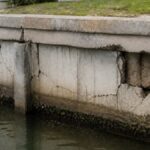
- Cracks running horizontally, vertically, or in a stair-step pattern
- Holes or spalling where concrete or stone is missing
- Leaning or bowing, the wall tilts away from the water or toward your property
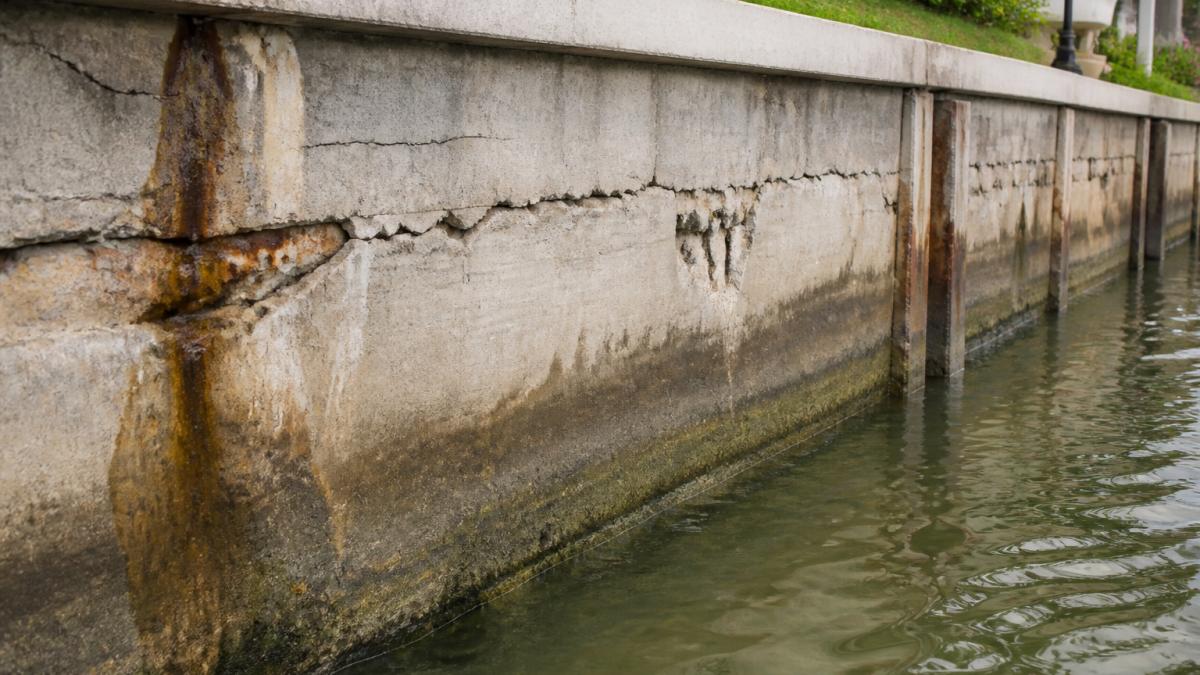
These visible signs often indicate deeper problems. A small crack can mask a large void behind the wall.
Hidden Problems: Voids, Soil Loss, and Water Pressure
The most dangerous damage is what you can’t see.
Voids develop when:
- Water seeps through joints and washes away soil
- The wall’s weep holes (designed to drain water) become blocked
- Hydrostatic pressure forces water through cracks
Soil loss is progressive. A small void grows larger each year. By the time you notice the wall moving, the damage may be extensive.
Professional divers or ground-penetrating radar can detect voids before they cause visible failure, a critical step in deciding between repair and replacement.
Seawall Repair vs Replacement: Know the Difference
Understanding the difference between repair and replacement helps you plan the right solution.
Repair: Patching and Joint Sealing
Seawall repair addresses specific damage without changing the wall’s structure. Common repairs include:
- Patching concrete cracks with epoxy or polyurethane sealant
- Sealing joints between wall sections to stop water infiltration
- Replacing damaged weep holes to restore drainage
Repairs work best for localized damage: if the wall is sound overall but has a few problem areas, repair extends its life affordably.
The limitation: repair doesn’t address underlying structural issues. If the wall is bowing or has extensive voids, patching won’t stop the failure.
Reinforcement: Tiebacks, Anchors, and Stabilization
Reinforcement strengthens a weakened wall without removing it, adding support and preventing further movement.
Tiebacks and anchors are steel rods or cables anchored deep into solid ground behind the wall; they pull the wall back into place and resist water pressure, working well for walls that are leaning but not yet failed.
Stabilization can also involve:
- Adding buttresses (concrete supports) on the water side
- Installing soldier piles (vertical steel beams) to support the wall face
- Grouting voids to restore soil support behind the wall
Reinforcement is more involved than simple repair but less disruptive than full replacement.
Seawall Replacement Methods That Avoid Full Removal
Several proven methods replace seawall without removing the existing structure from the ground. The right choice depends on wall material, damage extent, equipment access, and local shoreline approval.
Grout and Polyurethane Injection for Voids
Injection fills voids behind the wall with expanding foam or grout, restoring soil support and reducing the hydrostatic pressure that pushes the wall outward.
- Polyurethane is lightweight, cures quickly, and is largely unaffected by water, so it can be injected into wet voids. It is faster and less invasive than grout.
- Cementitious grout is heavier and more traditional. Some regulators prefer it because it is a known, inert material, but it can be harder to control in flowing water and adds weight to the wall.
Best for: Concrete, masonry, and vinyl walls with localized voids and intact foundation.
Limits and trade-offs: If voids are extensive or connected to open water, material can escape before it sets.
Steel Sheet Piling and Interlocking Systems
Sheet piling installs a new steel wall alongside the existing structure; the new wall carries the load while the old wall remains in place as backing.
Limits and trade-offs: Sheet piling requires heavy equipment, a stable working platform, and room to maneuver, and driving is noisy and may be seasonally restricted near sensitive habitat.
Concrete Overlay and Reinforcement Wrapping
Best for: Walls with surface damage, moderate structural weakness, or corroded reinforcement where the foundation is still sound. Wrapping is especially useful where added thickness or weight is a problem.
Limits and trade-offs: Neither method fixes voids behind the wall or a failed foundation. An overlay adds dead load, a problem on soft soils.
Adding a New Structural Face or Tiebacks
- New structural face: A new concrete or steel face is built in front of or behind the existing wall and tied to it, so the old wall becomes a form or backing. This is common when the existing face is spalled or eroded but the wall line and foundation are still usable.
- Tiebacks and anchors: Steel rods or cables are drilled through the wall and grouted deep into stable soil or rock behind it, then tensioned to pull the wall back toward plumb and resist overturning. Tiebacks work well for walls that are leaning but not yet failed, and they are often combined with injection to fill the voids the movement created.
Quick Comparison of In-Place Methods
|
Method |
Best wall condition |
Typical disruption |
Relative cost |
Key limit |
|---|---|---|---|---|
|
Polyurethane injection |
Localized voids, sound foundation |
Low, wall stays in service |
Low to moderate |
No added lateral strength |
|
Grout injection |
Localized voids, regulator preference |
Low to moderate |
Moderate |
Harder to control in flowing water |
|
Steel sheet piling |
Severely deteriorated wall, room for equipment |
High, heavy equipment, noise |
High |
Space, access, and noise restrictions |
|
Concrete overlay |
Surface damage, sound foundation |
Moderate |
Moderate |
Adds weight; does not fix voids |
|
Fiber wrapping |
Corrosion, moderate weakness |
Low to moderate |
Moderate |
Hides wall; needs dry surface |
|
New structural face |
Spalled face, usable foundation |
Moderate to high |
Moderate to high |
Requires tie-in to old wall |
|
Tiebacks and anchors |
Leaning wall, not yet failed |
Moderate |
Moderate |
Needs stable soil behind wall |
No single method is right for every wall. A common pattern combines injection to restore soil support with tiebacks or a new face to restore structural capacity, a hybrid approach that costs far less than full removal but delivers much of the same service life.
Seawall Replacement Cost and Budget Planning
Cost varies widely based on method, wall size, damage extent, access, and local labor rates. To budget, understand the cost drivers for each in-place method, then compare them against full removal and replacement.
How In-Place Methods Compare to Full Replacement
In-place methods are typically far less expensive than full removal and replacement, but the range is wide. A targeted repair or injection project might cost less than full removal and replacement of a residential seawall, which can be a significant investment.
What drives the number:
- Wall length and height, cost scales roughly with face area, not just linear feet.
- Material, concrete, wood, vinyl, and steel each carry different material and labor costs, and each fails differently.
- Damage severity, localized voids cost far less to treat than widespread soil loss or a rotated wall.
Method-Specific Cost and Timeline Drivers
Use this as a planning framework, not a quote. Actual numbers require a site inspection.
|
Method |
Main cost drivers |
Typical project duration |
Disruption |
|---|---|---|---|
|
Polyurethane injection |
Number of injection points, volume of foam |
Days |
Low, wall stays in service |
|
Grout injection |
Volume of grout, pumping time, testing |
Days to 1-2 weeks |
Low to moderate |
|
Tiebacks and anchors |
Number of anchors, depth to stable soil, tensioning |
1-3 weeks |
Moderate |
|
Concrete overlay |
Face area, thickness, doweling, curing time |
2-4 weeks |
Moderate |
|
Fiber wrapping |
Face area, surface prep, skilled labor |
1-2 weeks |
Low to moderate |
|
Steel sheet piling |
Pile length, driving conditions, equipment mobilization |
2-6 weeks |
High, noise, equipment, access |
|
New structural face |
Face area, tie-in detail, dewatering |
3-6 weeks |
Moderate to high |
|
Full removal and replacement |
Demolition, disposal, new wall, restoration |
4-12+ weeks |
High, loss of access, heavy equipment |
Permitting and Environmental Compliance Factors
Permitting is often the biggest source of schedule risk and varies by jurisdiction and waterbody. Understand Lee County dock permitting requirements that affect your seawall project timeline and costs.
Common approval layers to expect:
- Shoreline and wetland rules, work below the ordinary high water line, or in wetlands and mangroves, typically requires a permit or exemption from the state environmental agency and sometimes the federal corps of engineers.
- Local building and coastal construction rules, many coastal jurisdictions require a building permit, engineered drawings, and sometimes a coastal construction control line review.
- Protected species and habitat review, work windows may be restricted to protect nesting turtles, manatees, or seagrass.
A practical pattern: injection and patching projects are more likely to qualify for an exemption or minor permit, while sheet piling, new structural faces, and any work that changes the wall line almost always require a full permit and engineered plans.
Building a Realistic Budget
A defensible budget has four parts:
- Inspection and engineering, diver inspection, ground-penetrating radar, soil borings, and stamped drawings where required.
- Construction, the method itself, plus mobilization and access.
- Permitting and compliance, application fees, surveys, and any mitigation.
- Contingency, typically 10-20% for hidden voids or unexpected foundation conditions.
Getting a detailed estimate requires a professional inspection. At Crocker Marine, we provide free inspections to assess damage and recommend the most cost-effective approach, and our True Price Guarantee puts the full scope in writing before work begins.
Step-by-Step: Evaluating Your Seawall for In-Place Repair
Follow this process to determine whether your seawall can be repaired in place.
Step 1: Professional Inspection and Material Identification
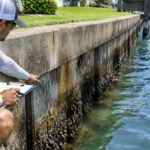
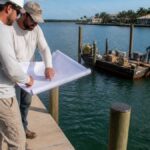
Schedule a marine inspection with a licensed contractor. The inspector will:
- Identify the wall material (concrete, wood, vinyl, steel, or hybrid)
- Document visible damage with photos and measurements
- Check for water seepage, cracks, and spalling
Material matters: concrete, wood, vinyl, and steel each fail and repair differently, and the inspector’s assessment guides which methods are viable.
Step 2: Structural Assessment and Damage Classification
The inspector may recommend additional testing:
- Diver inspection, a diver examines the wall below the waterline for hidden cracks, corrosion, or voids
- Ground-penetrating radar (GPR), detects voids and soil loss behind the wall without drilling
- Soil boring, samples soil behind the wall to assess compaction and stability
These tests reveal the true extent of damage: a wall that looks stable may have serious voids, while visible cracks might be cosmetic if the structure is sound.
Step 3: Feasibility Analysis and Method Selection
Based on inspection results, the contractor recommends whether repair, reinforcement, or replacement is appropriate.
Ask these questions:
- Is the wall foundation still stable?
- Are voids limited to one area or spread throughout?
- Can the wall be stabilized with injection or tiebacks?
The contractor should present options with pros, cons, and realistic costs for each.
Getting Your Seawall Inspected and Quoted
The best way forward is a professional evaluation.
Request a seawall inspection to get a detailed assessment and quote. Request an assessment from our team to evaluate your seawall and discuss repair or replacement options.
Whether your seawall needs repair, reinforcement, or full replacement, the right choice depends on facts, not assumptions. Let a professional inspection guide your decision.
A failing seawall threatens your property value, safety, and waterfront access, but replacement doesn’t always mean full removal.
Frequently Asked Questions
Can you replace a seawall without removing the existing wall?
Yes, in many cases. In-place replacement methods allow you to reinforce or rebuild a seawall while the existing structure remains in place. Techniques like grout injection, polyurethane injection, steel sheet piling, and concrete overlays can stabilize and extend the life of your seawall without full removal. However, severely damaged walls with extensive soil loss, major structural failure, or compromised foundations may require removal. A professional inspection determines which method suits your specific wall condition.
What are common seawall damage signs that indicate repair is needed?
Watch for visible cracks, holes, and leaking joints in the wall surface. Sagging or bowing indicates loss of structural stability from water pressure and soil erosion behind the wall. Weeping or seeping water suggests voids and soil loss. A professional marine inspection can identify hidden problems like backfill erosion and hydrostatic pressure damage that aren’t visible from the surface.
How much does seawall replacement cost compared to repair?
In-place repair and reinforcement methods can be less expensive than full seawall replacement, depending on damage extent and wall material. Exact pricing depends on wall length, material type (wooden, concrete, steel), damage severity, and access conditions. Environmental permits and shoreline compliance may add to costs. Contact a licensed contractor for a detailed repair estimate and replacement cost comparison specific to your property.
What’s the difference between seawall repair and replacement?
Repair involves patching cracks, sealing joints, and addressing surface damage to extend the wall’s service life. Replacement rebuilds the structural wall itself, either by full removal or in-place methods like injection systems and reinforcement. Repair works best for minor damage and extends a seawall’s life. Replacement is necessary when structural failure, extensive soil loss, or major cracks threaten the wall’s ability to resist water pressure and erosion.