Table of Contents
- Why Pontoon Boats Need Specialized Lift Systems
- Pontoon Boat Lift Types: Floating, Fixed, and Hybrid Systems
- Pontoon Boat Lift Capacity: Sizing for Weight Distribution
- Boat Lift Water Depth Requirements and Waterway Conditions
- Can You Convert a Boat Lift to Pontoon Lift? Adapting Existing Systems
- Installation, Maintenance, and Long-Term Ownership Costs
- Safety Checks and Common Fitment Mistakes to Avoid
- Frequently Asked Questions
Last Updated: October 21, 2026
Why Pontoon Boats Need Specialized Lift Systems
Pontoon boats sit differently in the water than monohull vessels. Their three-pontoon design distributes weight across multiple floats, so a standard boat lift won’t support them properly, and that changes everything about how you choose the right system.
A pontoon boat lift must account for the load-bearing characteristics of foam-filled floats and the demands of a three-pontoon hull. Without proper support, you risk damaging the pontoons or stressing the frame.
Adapting a standard boat lift to a pontoon rarely works well, cradle configuration, bunk placement, and weight distribution requirements are too different. Start your search with lifts specifically engineered for pontoon boats.
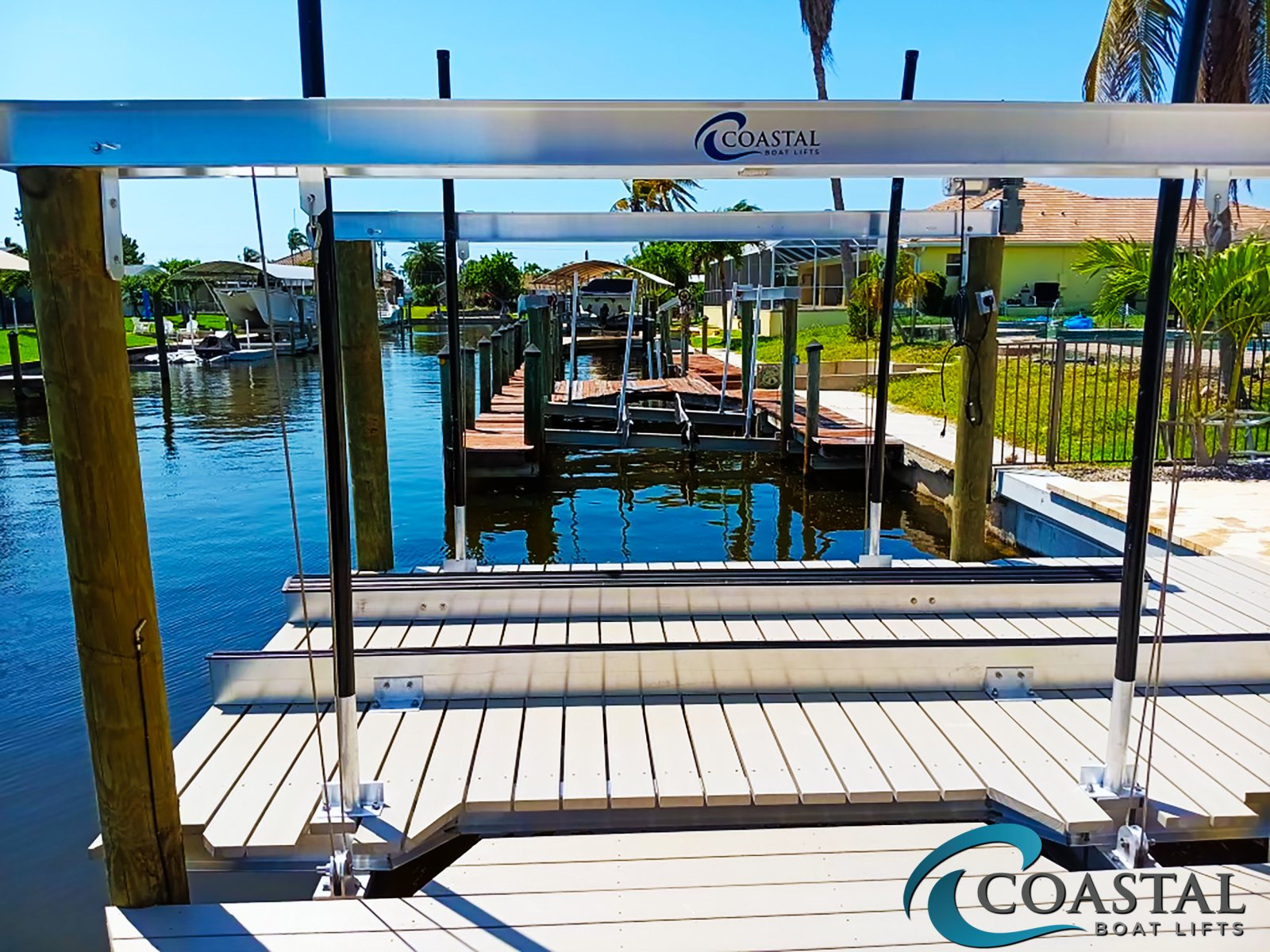
Diagram illustrating how specialized cradle supports secure pontoon boats, the best boat lift options for pontoon boats.
Pontoon Boat Lift Types: Floating, Fixed, and Hybrid Systems
The best boat lift options for pontoon boats fall into three main categories. Each has distinct advantages depending on your waterway conditions and long-term needs.
Floating Lifts for Variable Water Levels
A floating lift rises and falls with the water level, making it ideal for areas with significant tidal range or seasonal fluctuations.
If your dock sees 4+ feet of tidal swing, a floating system saves constant adjustment headaches. The cradle and bunks stay at a consistent height relative to the boat, so launching and loading remain straightforward regardless of tide.
The trade-off is durability. Floating systems experience more wear from constant movement. Fasteners loosen over time, and the support structure endures continuous stress from wave action and tide cycles. Regular maintenance becomes essential to keep everything functioning safely.
Fixed and Shore-Mounted Lifts for Stable Conditions
Fixed lifts are anchored to the seafloor or dock structure with pilings or a concrete foundation.
Fixed systems excel in protected coves, calm lagoons, or areas where water level variation stays under 2 feet. Once installed correctly, they demand less maintenance than floating alternatives because the structural beams don’t flex constantly, extending fastener lifespan and reducing seasonal wear.
Installation complexity is higher with fixed lifts. You’ll need accurate depth surveys, proper pilings driven to adequate depth, and professional assessment of bottom composition. If conditions change, if dredging occurs upstream or drought lowers water levels, a fixed lift can become problematic.
Hydraulic Versus Winch-Operated Systems
Hydraulic lifts use pressurized fluid to raise and lower the boat. The system is smooth, powerful, and requires minimal physical effort, you operate it with a remote or button.
Winch-operated lifts use an electric or manual winch to pull the boat up via cables or straps. They’re simpler mechanically, with fewer components to maintain and lower initial cost.
Hydraulic systems require periodic fluid checks and seal maintenance. If a hydraulic line fails, you need specialized service. Winch systems demand cable inspection and motor maintenance, but parts are more standardized and easier to source.
Pontoon Boat Lift Capacity: Sizing for Weight Distribution
Choosing the right capacity is non-negotiable. An undersized lift strains the system and risks failure; an oversized one wastes money and dock space. The key is calculating your loaded boat weight accurately.
Calculating Loaded Boat Weight
Start with the manufacturer’s dry weight, then add realistic operating loads: fuel, fresh water, passengers, and typical gear.
Use the maximum weight you’ll ever load onto the boat. If you occasionally host eight people for a day cruise, factor that in. A lift rated for 12,000 pounds gives you safety margin and longevity.
Using only the dry weight leads to undersizing, slow operation, premature wear, and potential safety issues. The lift should handle your loaded boat weight at 70-80% of its rated capacity.
Three-Pontoon Hull Support and Balanced Cradle Configuration
A three-pontoon hull requires three distinct contact points. The cradle’s bunks must contact each pontoon at its strongest structural point, typically about one-third from each end. Unbalanced contact creates stress concentration and can damage the floats over time.
The cross-beams connecting the three support points must be rigid enough to prevent flexing, which transfers load unevenly and accelerates wear. Professional installation ensures the cradle geometry matches your boat’s pontoon spacing and diameter.
Weight distribution matters as much as total capacity. A 10,000-pound boat distributed evenly across three pontoons puts about 3,300 pounds on each float.
Boat Lift Water Depth Requirements and Waterway Conditions
Water depth determines whether a fixed or floating system makes sense, and it affects the type of lift you can install.
Minimum and Maximum Depth Specifications
Most pontoon boat lifts require a minimum of 4-5 feet of water at the shallowest point of your dock so the boat can rest fully on the cradle without touching bottom.
Maximum depth is less restrictive. Floating lifts work in water up to 20+ feet deep; fixed lifts depend on piling depth and anchoring.
Check depth across all seasons. Summer drought can lower water levels by 2-3 feet, so survey your waterway at its lowest expected level, a 5-foot minimum could leave you unable to launch or retrieve your boat.
Tidal Range, Bottom Composition, and Dock Configuration
Tidal range is the difference between high and low tide. In Southwest Florida, some areas experience 2-3 feet of range, while others see minimal variation.
Bottom composition affects piling installation for fixed lifts. Sandy bottoms require deeper pilings or larger-diameter posts to prevent settling; rocky or shell-bottom areas allow shallower pilings but demand precise drilling.
Your dock configuration influences lift placement, a narrow dock might not fit a wide floating platform, and an existing structure might not support additional pilings. Have a professional assess your setup before committing to a lift type.
Can You Convert a Boat Lift to Pontoon Lift? Adapting Existing Systems
Many waterfront property owners ask whether they can retrofit a standard boat lift to work with their new pontoon. The answer depends on the lift’s design and your boat’s specifications.
When Retrofit Conversion Works
A retrofit works when the existing lift has adjustable bunks and a frame wide enough for your pontoon’s spacing. Some quality lifts feature removable cradle components that let you reposition bunks for a three-pontoon configuration.
The most common successful retrofit adds custom support brackets to an existing cradle, a fabricator welds new bunk positions to match your pontoon spacing.
Before pursuing a retrofit, have a marine professional evaluate the specific lift model and your boat. They’ll determine whether the frame can be safely modified and whether the existing support system can handle your boat’s weight distribution.
When Full Replacement Makes Better Sense
Full replacement is right when the existing lift is too small, too narrow, or structurally compromised.
Age and condition matter. A 20-year-old lift with corroded fasteners and worn seals isn’t a good retrofit candidate, saltwater may have weakened the structure, and modifications often cost nearly as much as replacing it.
Replacement gives you modern efficiency, better safety features, and a warranty. A new pontoon boat lift engineered for your specific boat and waterway conditions will outperform any retrofit. The peace of mind is worth the investment.
Installation, Maintenance, and Long-Term Ownership Costs
Understanding the full cost picture helps you make the right choice for your situation.
Professional Installation and Permit Requirements
Professional installation for a pontoon boat lift typically requires a licensed marine contractor. Most municipalities require permits for dock modifications and lift installation.
Installation labor depends on lift type and site conditions. A floating lift installation is generally faster than driving pilings for a fixed system. Waterway access, existing dock structure, and bottom conditions all affect installation time and cost.
Don’t attempt DIY installation unless you have marine construction experience. Improper installation creates safety hazards and voids warranties. A professional ensures the lift is level, properly secured, and aligned to support your boat correctly.
Seasonal Maintenance and Durability Against Saltwater
Saltwater environments accelerate corrosion. Fasteners, hydraulic lines, electrical connections, and metal support structures all degrade faster in salt air and brackish water. Regular rinsing with fresh water after use extends lift lifespan significantly.
Hydraulic lifts require annual fluid checks and seal inspections. Winch systems need cable examination and motor lubrication. Floating lift pontoons should be inspected for cracks or water intrusion annually.
A well-maintained pontoon boat lift lasts 15-20 years in saltwater conditions. Neglected lifts deteriorate in 8-10 years. The difference is regular care and prompt repairs. Budget for annual maintenance and occasional component replacement.
Safety Checks and Common Fitment Mistakes to Avoid
Safety is non-negotiable. A lift failure can damage your boat, injure people, or create liability issues.
Verifying Lift Width, Length, and Structural Beam Alignment
Measure your pontoon boat’s exact dimensions before purchasing a lift. The lift cradle width must accommodate the distance between your outer pontoons with at least 6 inches of clearance on each side.
Structural beam alignment determines how evenly weight distributes. If the cross-beams don’t align parallel to your boat’s length, the cradle will twist under load. This creates uneven support and accelerates wear.
Check that all fasteners are tight before first use. Vibration and wave action loosen bolts over time. A loose fastener might seem minor, but it’s the beginning of cascading failures.
Testing Weight Distribution and Launch System Operation
Before loading your boat onto the lift for the first time, test the system empty. Raise and lower it several times to verify smooth operation. Listen for unusual sounds, grinding, squeaking, or clunking indicates misalignment or mechanical problems.
Load your boat slowly during the first launch. Watch for any tilting or uneven settling. The boat should rest level on the cradle with equal weight on all three contact points.
Test the emergency lowering system if your lift has one. Know how to manually lower the boat if power fails. This knowledge could prevent disaster during a storm or equipment malfunction.
Selecting the best boat lift options for pontoon boats requires understanding your waterway, your boat’s weight and dimensions, and your long-term maintenance capacity. Our team handles permitting, installation, and ongoing support. Get A Quote from Crocker Marine and discover how a properly engineered lift transforms your boating experience.
|
Lift Type |
Best For |
Key Advantage |
Primary Consideration |
|---|---|---|---|
|
Floating Lift |
Variable water levels, tidal areas |
Adjusts automatically with tide |
Requires more frequent maintenance |
|
Fixed Lift |
Stable water depth, calm coves |
Superior durability, minimal adjustment |
Needs accurate depth survey, pilings |
|
Hydraulic System |
Convenience, larger boats |
Smooth, remote-controlled operation |
Requires periodic fluid and seal service |
|
Winch System |
Simplicity, lower initial cost |
Straightforward mechanics, easy repairs |
Manual effort or motor-dependent operation |
Frequently Asked Questions
What is the ideal water depth for a boat lift?
Most pontoon boat lifts require a minimum water depth of 3 to 4 feet at low tide to operate safely. Maximum depth typically ranges from 8 to 12 feet, depending on the lift model and system type. Floating lifts adapt to tidal changes, while fixed lifts need consistent depth. Check your specific waterway’s tidal range and bottom composition before selecting a lift—sandy or muddy bottoms may require deeper footings than rocky surfaces.
What type of boat lift is best for a pontoon boat?
Floating lifts are often ideal for pontoon boats because they rise and fall with water levels, eliminating depth concerns. Fixed hydraulic lifts work well in stable, deep-water conditions. The best choice depends on your boat weight, water depth, tidal range, and dock configuration. Tritoons and larger pontoons benefit from lifts with reinforced cradles and cross-beam support to distribute weight across all three pontoon floats evenly.
How do you choose the right capacity for a pontoon boat lift?
Calculate your loaded boat weight by adding the dry weight (from your boat’s specifications), fuel, water, passengers, and gear. Most pontoon boats range from 4,000 to 10,000 pounds loaded. Select a lift rated 20 percent above your loaded weight to account for safety margin and future upgrades. For tritoons, ensure the lift cradle and bunks support all three pontoon floats equally to prevent tilting or structural strain.
Can you convert a regular boat lift to a pontoon lift?
Conversion is possible if the existing lift’s capacity, width, and cradle configuration can accommodate your pontoon’s dimensions and weight. Retrofitting may require new cradle inserts, additional cross-beams, or reinforced bunks to properly support multiple pontoon floats. Many older single-boat lifts lack the structural beams needed for pontoon weight distribution, making full replacement more cost-effective and safer than adapting an incompatible system.