You finally found the perfect waterfront property in Southwest Florida. The dock is in place, your boat is ready, and now you need a boat lift to protect your investment. Then the question hits you: do you have enough water depth?
Water depth requirements represent one of the most critical factors in boat lift selection and installation. Get it wrong, and you face expensive modifications, operational headaches, or discovering your waterfront cannot accommodate a lift at all. For Southwest Florida boat owners, understanding these requirements becomes even more complex due to tidal variations, seasonal changes, and diverse waterfront environments.
At Crocker Marine Services, we evaluate water depth conditions daily across Cape Coral, Fort Myers, Naples, and throughout Southwest Florida. After installing hundreds of boat lifts in varying conditions, we know exactly what works and what causes problems down the line.
This guide explains everything you need to know about water depth requirements for boat lifts, from minimum specifications to solutions for challenging situations.
Understanding Minimum Water Depth Requirements for Boat Lifts
The water depth at your dock determines which boat lift options will work for your property. Too shallow, and you face limited choices or need costly modifications. Adequate depth opens up reliable, long-lasting solutions.
Standard Depth Requirements
Most traditional boat lifts require a minimum water depth between 2.5 and 4 feet at low tide. This range accommodates the lift structure, cradle beams, and necessary clearance for your boat hull.
The specific depth requirement depends on several factors:
- Boat size and weight: Larger vessels need deeper water and more substantial lift structures
- Lift type and design: Different lift mechanisms have varying depth needs
- Cradle beam size: Heavier boats require larger beams that sit deeper in the water
- Hull design: Deep-V hulls need more clearance than flat-bottom boats
- Lift manufacturer specifications: Each brand has minimum depth requirements
A 10,000-pound boat on a standard 4-post lift typically needs 3 to 3.5 feet of water depth at low tide. Heavier boats often require 4 feet or more to accommodate the structural components and provide adequate support.
Factors That Affect Depth Needs
Beyond the basic measurements, several conditions influence your actual depth requirements.
Water bottom composition plays a significant role. Soft mud bottoms may require pilings driven deeper, effectively reducing available water depth. Hard sand or rock provides better support but may limit installation options.
Your boat’s specific characteristics matter tremendously. A 25-foot center console with a shallow draft has different needs than a 25-foot cabin cruiser with a deep-V hull. The lowest point of your hull determines minimum clearance requirements.
Local regulations can also impact depth considerations. Some Florida waterways have restrictions on dredging or piling placement that affect your options.
How Different Boat Lift Types Impact Depth Requirements
Boat lift technology has evolved to address varying water depth situations. Understanding your options helps you match the right lift to your specific conditions.
Traditional 4-Post Boat Lifts
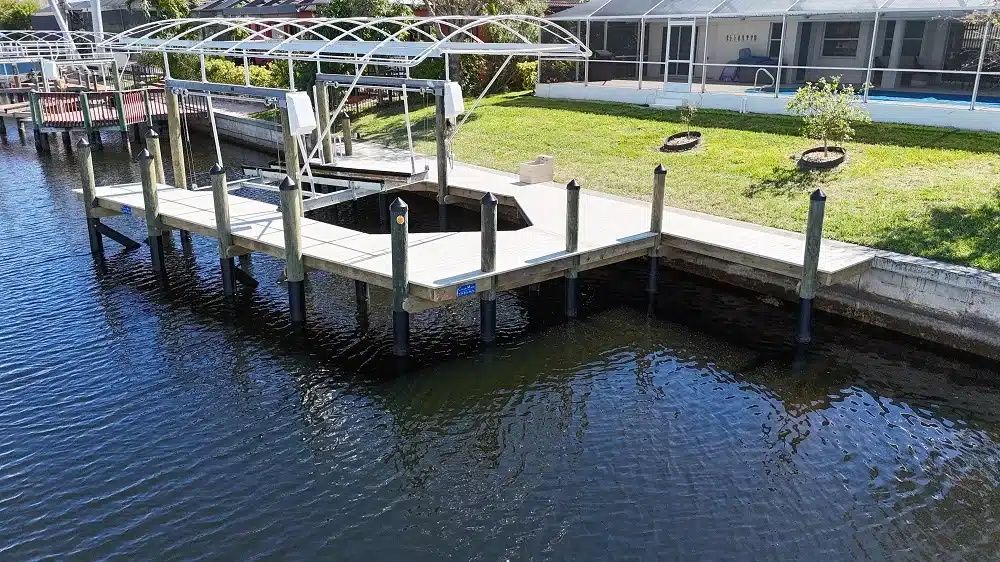
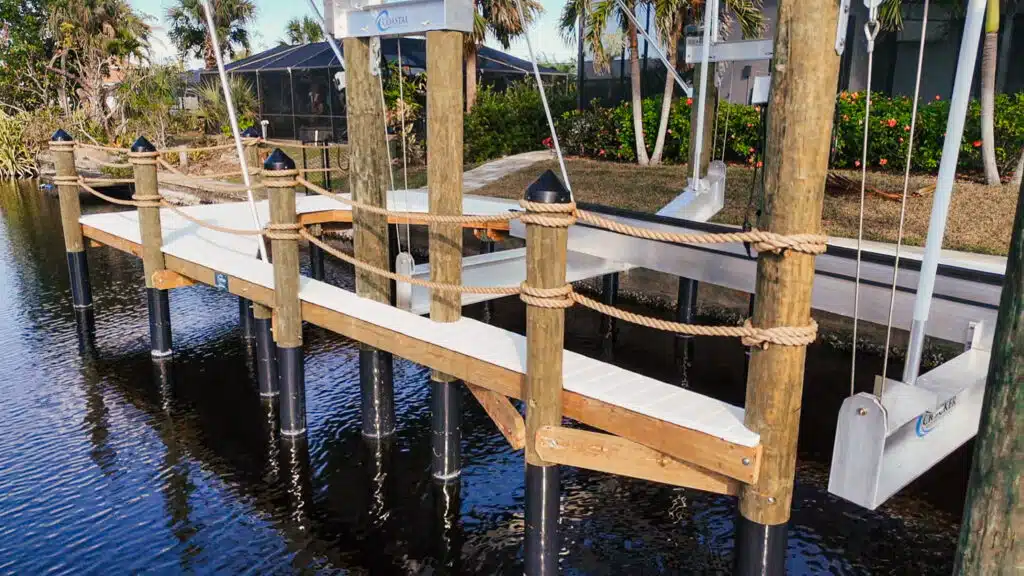
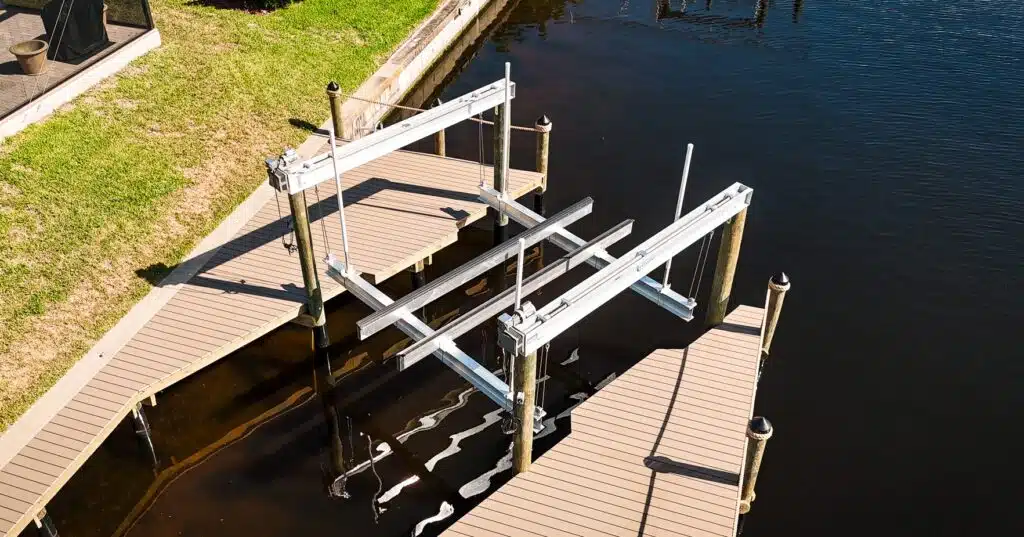
The most common boat lift design uses four corner posts with a cradle suspended between them. These lifts offer excellent stability and capacity for boats up to 30,000 pounds or more.
Traditional 4-post lifts typically require:
- Minimum 3 feet of water depth at low tide for boats under 10,000 pounds
- 3.5 to 4 feet for boats between 10,000 and 20,000 pounds
- 4 to 5 feet for larger vessels over 20,000 pounds
The cradle beams on these lifts sit in the water when lowered. Beam size increases with boat weight, requiring progressively deeper water. A lift rated for 16,000 pounds uses substantially larger beams than one rated for 8,000 pounds.
These lifts work exceptionally well in Southwest Florida’s canal systems where consistent depth exists. They provide reliable performance and straightforward maintenance.
Elevator Lifts for Shallow Water
Elevator lifts, also called vertical lifts, offer solutions for shallow water situations. Instead of a submerged cradle, these lifts use a platform that travels vertically on guide posts.
Key advantages for shallow water include:
- Platform stays above water when lowered
- Minimal depth requirements, often 2 to 2.5 feet
- Works in areas where traditional lifts cannot function
- Protects boats from marine growth and barnacles
Elevator lifts cost more than traditional 4-post designs, but they solve depth challenges that would otherwise prevent lift installation. The platform design also keeps your boat completely out of the water, reducing maintenance and bottom paint needs.
These lifts shine in areas with significant tidal ranges or seasonal water level changes. The boat remains accessible regardless of tide conditions.
Floating Boat Lift Options
Floating lifts provide another alternative for challenging depth situations. These systems use air-filled tanks or pontoons to raise boats out of the water.
Floating lifts work in water as shallow as 18 to 24 inches, making them viable for extremely shallow areas. The lift floats on the surface and requires minimal bottom clearance.
However, floating lifts have limitations:
- Lower weight capacities than fixed lifts
- Less stability in rough water or strong currents
- Require adequate space for the floating platform
- May not be suitable for all waterfront configurations
For Southwest Florida properties with very shallow water, floating lifts can provide a workable solution when other options fail.
Southwest Florida’s Unique Tidal Considerations
Tidal variations add complexity to water depth calculations in our region. What looks like adequate depth at high tide may become problematic when the tide goes out.
How Tides Affect Water Depth Calculations
Southwest Florida experiences semi-diurnal tides with two high tides and two low tides daily. The range between high and low tide varies by location and season.
In Cape Coral and Fort Myers, typical tidal ranges run 2 to 3 feet. During spring tides, the range can reach 4 feet or more. This variation means your water depth changes significantly throughout the day.
When determining adequate depth for a boat lift, always measure at mean low water or lower. A location with 4 feet of water at high tide might have only 1.5 feet at low tide, making it unsuitable for most lifts.
Accounting for Low Tide Conditions
Professional boat lift installers measure depth at the lowest expected tide levels. This ensures your lift functions properly regardless of tidal conditions.
Consider these scenarios:
A dock with 3.5 feet of water at mean tide might seem adequate for a standard lift. However, during spring low tides, depth could drop to 2 feet, causing the lift cradle to rest on the bottom. This creates stress on the lift mechanism and prevents proper operation.
Measuring at low tide reveals the true working depth. You need sufficient clearance for the cradle beams, adequate water for the boat hull, and room for the lift to lower completely without grounding.
Seasonal Water Level Variations
Beyond daily tides, Southwest Florida experiences seasonal water level changes. Winter typically brings lower water levels, while summer and fall see higher levels.
Drought conditions can reduce water depth by 6 to 12 inches or more in canals and waterways connected to inland systems. Heavy rain periods raise levels temporarily.
These seasonal variations mean you need a buffer beyond minimum requirements. A lift that works fine in summer might ground out during winter dry season if you cut depth margins too close.
Solutions for Shallow Water Situations
Inadequate water depth does not automatically disqualify your property from having a boat lift. Several solutions can address depth challenges.
When Dredging Makes Sense
Dredging removes bottom material to increase water depth. This option works well when you have 1 to 2 feet less depth than required.
Dredging makes sense when:
- You need to deepen a small area under your dock
- Local regulations permit dredging in your waterway
- Bottom composition allows effective removal
- Cost justifies the benefit of installing your preferred lift type
In Southwest Florida, dredging typically requires permits from the Florida Department of Environmental Protection and possibly the Army Corps of Engineers. The process takes time but provides a permanent solution to depth limitations.
Dredging costs vary based on depth needed, bottom composition, and access. Removing 1 to 2 feet of material under a standard dock area might cost $3,000 to $8,000 or more, depending on specific conditions.
Alternative Lift Options
When dredging is not practical or permitted, alternative lift designs provide solutions.
Shallow water lifts use modified cradle designs that require less depth. These specialized lifts accommodate depth restrictions while still providing reliable boat support.
Elevator lifts, as mentioned earlier, work in water as shallow as 2 to 2.5 feet. The higher initial cost often proves worthwhile compared to dredging expenses and permitting hassles.
Floating lifts handle the shallowest conditions but work best for lighter boats. A 6,000-pound boat might work perfectly on a floating lift in 20 inches of water.
Cost Considerations
Addressing shallow water adds expense to your boat lift project. Understanding the costs helps you make informed decisions.
Standard 4-post lift installation for a 10,000-pound boat might cost $12,000 to $18,000. An elevator lift for the same boat could run $18,000 to $28,000. Dredging adds $3,000 to $10,000 depending on scope.
The True Price Guarantee from Crocker Marine Services means no surprise costs during installation. We assess your specific situation, determine the best solution, and provide a fixed price that includes addressing any depth challenges.
How to Accurately Measure Your Water Depth
Accurate depth measurement prevents problems during installation and ensures you select the right lift for your conditions.
DIY Measurement Tips
Homeowners can perform preliminary depth measurements using simple tools:
- Use a weighted line or measuring tape with a weight attached
- Lower the weight to the bottom at low tide
- Measure from the water surface to the bottom
- Take measurements at multiple points under your dock
- Note the date, time, and tide level when measuring
Measure at the four corners where lift pilings would be installed plus the center area where your boat hull will sit. Bottom contours vary, and you need to know the shallowest point.
Check tide charts for your area and measure during predicted low tide. For the most conservative assessment, measure during spring low tide when water levels reach their lowest point.
Document your measurements with photos and notes. This information helps when discussing options with lift installers.
Professional Assessment Benefits
Professional assessment provides accuracy that DIY measurements cannot match. Experienced installers bring specialized tools and knowledge of local conditions.
A professional assessment includes:
- Precise depth measurements using calibrated equipment
- Bottom composition evaluation
- Tidal range analysis for your specific location
- Structural assessment of existing dock
- Evaluation of access for installation equipment
- Review of local regulations and permit requirements
At Crocker Marine Services, we provide free on-site consultations that include comprehensive depth assessment. We measure your specific conditions, explain your options, and recommend the best lift solution for your situation.
Professional assessment also reveals issues you might miss. Soft bottom that will not support pilings, underground utilities, or dock structural limitations all affect lift installation feasibility.
What Happens If Water Depth Is Insufficient?
Installing a boat lift without adequate water depth creates multiple problems that compromise performance and longevity.
Installation Challenges
Insufficient depth makes proper installation difficult or impossible. Lift pilings must be driven to adequate depth for stability. Shallow water with hard bottom may prevent achieving proper piling depth.
The lift cradle needs clearance to lower completely. Without enough depth, the cradle rests on the bottom when lowered, preventing proper boat positioning and creating stress on the lift mechanism.
Installation crews may encounter unexpected obstacles when working in marginal depths. Hard rock, buried debris, or bottom irregularities become more problematic in shallow conditions.
Operational Problems
Even if installation succeeds, inadequate depth causes ongoing operational issues.
The lift may not lower far enough for easy boat loading. You end up climbing over high gunwales or struggling to board. Launching and retrieving becomes difficult and potentially dangerous.
During low tide, the cradle grounds out. This prevents lowering the boat fully and can bend or damage cradle beams. The lift motor strains against the resistance, leading to premature wear.
Your boat hull may contact the bottom when the lift is lowered. This damages gel coat, through-hull fittings, and running gear. One hard grounding can cause thousands in repair costs.
Long-Term Concerns
Chronic depth problems accelerate lift wear and create safety hazards.
Lift mechanisms working against grounded cradles experience excessive wear. Motors, cables, and pulleys fail prematurely. What should be a 20-year lift becomes a 10-year lift with constant repairs.
Structural stress from improper operation can cause piling movement or failure. A loose or leaning lift becomes dangerous and may collapse.
Your boat suffers ongoing damage from inadequate clearance. Bottom paint wears off, gel coat chips, and marine growth accumulates. The lift that should protect your investment instead contributes to deterioration.
Expert Recommendations for Southwest Florida Waterfront Properties
After years of installing boat lifts throughout Southwest Florida, we have learned what works reliably in our unique conditions.
Minimum Recommended Depths by Boat Size
Based on local conditions and proven performance, we recommend these minimum depths measured at mean low water:
Boats under 5,000 pounds:
- Minimum 2.5 feet for elevator lifts
- Minimum 3 feet for traditional 4-post lifts
Boats 5,000 to 10,000 pounds:
- Minimum 3 feet for elevator lifts
- Minimum 3.5 feet for traditional 4-post lifts
Boats 10,000 to 20,000 pounds:
- Minimum 3.5 feet for elevator lifts
- Minimum 4 feet for traditional 4-post lifts
Boats over 20,000 pounds:
- Minimum 4 feet for any lift type
- Consider 4.5 to 5 feet for optimal performance
These recommendations include safety margin for tidal variations and seasonal changes. Properties with these depths accommodate standard lift installations without modifications.
Special Considerations for Canal Properties
Southwest Florida’s extensive canal systems present specific depth considerations. Many canals were dredged to specific depths that may limit lift options.
Older canals in Cape Coral and Fort Myers often have 3 to 4 feet of depth, adequate for most applications. Newer developments typically provide 5 to 6 feet, offering excellent conditions for any lift type.
Canals connected to inland water systems experience more seasonal variation than those with direct Gulf access. Factor in an extra 6 to 12 inches of potential water level drop during dry season.
Dead-end canals may have more silt accumulation, reducing effective depth over time. Properties on these canals benefit from conservative depth margins.
When to Consult a Professional
Contact a professional boat lift installer when:
- Your preliminary measurements show borderline depth
- You have questions about which lift type suits your conditions
- Tidal range in your area exceeds 2 feet
- Your waterfront has unusual characteristics
- You want to avoid costly mistakes
Professional consultation costs nothing but provides valuable information. You learn exactly what will work at your property and receive accurate pricing without surprises.
Crocker Marine Services provides free on-site assessments throughout Southwest Florida. We measure your specific conditions, explain your options clearly, and provide fixed pricing backed by our True Price Guarantee. No change orders, no surprise costs, just straightforward solutions.
Water Depth Determines Your Options
Water depth at your dock fundamentally determines which boat lift solutions will work reliably. Most traditional lifts need 3 to 4 feet at low tide, while elevator lifts function in as little as 2.5 feet. Floating lifts handle the shallowest conditions but have weight limitations.
Southwest Florida’s tidal variations require measuring depth at low tide and accounting for seasonal changes. What appears adequate at high tide may prove insufficient when water levels drop.
Solutions exist for shallow water situations. Dredging, specialized lift designs, and alternative lift types can address depth challenges. Professional assessment reveals the best approach for your specific property.
Attempting to install a lift without adequate depth creates installation difficulties, operational problems, and long-term damage to both the lift and your boat. The cost of addressing depth issues upfront proves far less than dealing with chronic problems later.
Accurate depth measurement and professional guidance ensure you select the right lift for your conditions. This protects your investment and provides years of reliable service.
Get Expert Assessment of Your Water Depth
Wondering if your waterfront has adequate depth for a boat lift? Crocker Marine Services provides free on-site evaluations throughout Southwest Florida.
We measure your specific conditions, explain which lift options work best, and provide fixed pricing backed by our True Price Guarantee. No surprises, no change orders, just honest assessment and reliable solutions.
Our team has installed hundreds of boat lifts in every imaginable water depth condition from Marco Island to Sarasota. We know what works in Southwest Florida’s unique environment.
Call (239) 841-9674 to schedule your free consultation. We respond within minutes and can typically schedule your assessment within days.
Licensed, insured, and committed to your satisfaction. CBC1266139